

Questions we receive
Questions About Choosing and Using Men's Supplements
These are the questions readers send us most often, grouped by what they are actually about: choosing a product, reading a label, and using one day to day. Answers stay inside product information. We do not interpret symptoms or suggest products for a personal situation.
The questions, with answers
Six groups, each one a question readers actually open. Expand what applies to you. If you need the ingredient detail behind any answer, the Ingredient Guide goes deeper than a short FAQ entry can.
Read the Ingredient GuideAlso useful: Product Comparisons and Daily Routine & Lifestyle.
Choosing between two products
Which three things should I compare first?
Start with serving size. A product taken twice a day is a different commitment from one taken once. Then compare the amounts of the ingredients you care about, not the length of the ingredient list. Finally, check the pack duration against how long you plan to use it. Those three details resolve most comparisons before brand enters the picture.
Does a longer ingredient list mean more value?
Not on its own. A panel with twelve ingredients at unclear amounts tells you less than a panel with six, each carrying a stated daily value. When you compare men's vitamin formulas, the quantity per ingredient is the number that matters, and the length of the list is the number that sells. Look for the ones where both the vitamin and mineral amounts are visible.
How long should a first pack be?
Match the pack to your intended routine, not to a discount ladder. If you take one capsule a day and the pack holds sixty, you are holding two months. Buying three different products at the same time, even well chosen, leaves you unable to tell which one your routine is sitting on. Start with the pack you can finish before the expiry date.
Reading a label correctly

Dried botanicals and minerals, laid out for a side-by-side read.
Read in order
The panel, top to bottom
- 1 Vitamins and minerals with amounts stated — the part you can actually compare between two products.
- 2 Botanical section — often one total milligrams figure rather than a per-extract breakdown. When it is one total weight, you cannot tell how much of each extract is in the capsule.
- 3 Other-ingredients line — the capsule shell, fillers and anti-caking agents. Useful if you already know which carriers you prefer to skip.
- 4 Directions and the number of tablets per daily serving — the line that quietly decides how long the bottle really lasts.
Per tablet or per daily serving — which number am I reading?
The header above the table usually tells you. If it says per tablet and the directions say take two, the daily amounts are double what you first read. This single detail changes how long a bottle lasts, how the daily cost compares against a second product, and how many units you actually need per order. Read the header before reading the numbers.
What does the expiry date actually mark?
It marks the point up to which the product is intended to keep its stated quality when stored as directed. It assumes the bottle stayed closed, dry and out of the sun — which is exactly why the next question about storage matters more in a tropical climate than it does in a temperate one.
Which label claims should I ignore?
Any phrase on the front of the box that promises a result instead of naming an ingredient. The back panel is where products can be compared honestly: amounts, serving size, directions, storage line, importer line. Front-panel words are chosen to sell, and they are the same words on a dozen different bottles.
Common beginner mistakes
Mistake one
Starting three products at once
It feels efficient, and it makes your first month unreadable. If you begin an energy and endurance formula and a general multivitamin on the same Monday, you have no way to tell what you are responding to. Introduce one at a time, keep the rest of your routine the same, and give each one a few weeks before the next.
Mistake two
Judging by the front of the box
A longer ingredient banner reads as more value, and it rarely is. A shorter panel with clear daily values is easier to evaluate than a long one with hidden amounts. Compare two products by the numbers beside each ingredient, not by the size of the list. Both of these mistakes are cheap to avoid and expensive to repeat.
Imported brands, local sellers and storage
The same product appears under several sellers. How do I choose?
The same imported product often appears under several sellers with different photos and prices. Check the importer line, the expiry date, and whether the listing shows the actual pack. A seller who photographs the real product is easier to evaluate than one who reuses a manufacturer image. Price alone tells you very little about what will arrive.
How should I store natural supplements in Indonesia?
Heat and humidity are the two factors that shorten shelf life fastest here. Keep products in a closed cupboard, away from the stove and away from direct sun. Leave the desiccant packet in the bottle and keep the original container — a decanted jar loses the date, the batch and the moisture protection all at once. If a product changes colour or smell before its expiry date, treat that as a reason to stop using it.
Can a product be taken with others I already use?
That question depends on what else is in your routine and on details only a qualified professional can weigh. We describe what is inside a formula and how it is formatted — capsules, tablets, sachets, softgels — so you can bring a clear list to that conversation instead of a photo of a box.
Where our answers stop
What this site cannot answer
We cannot tell you whether a product suits your personal situation, and we do not try. Questions about symptoms, existing conditions, or products you already take belong with a qualified professional, not with a product-information site. If your question is about ingredients, formats, labels, or daily routine, send it to us and we will answer it here.
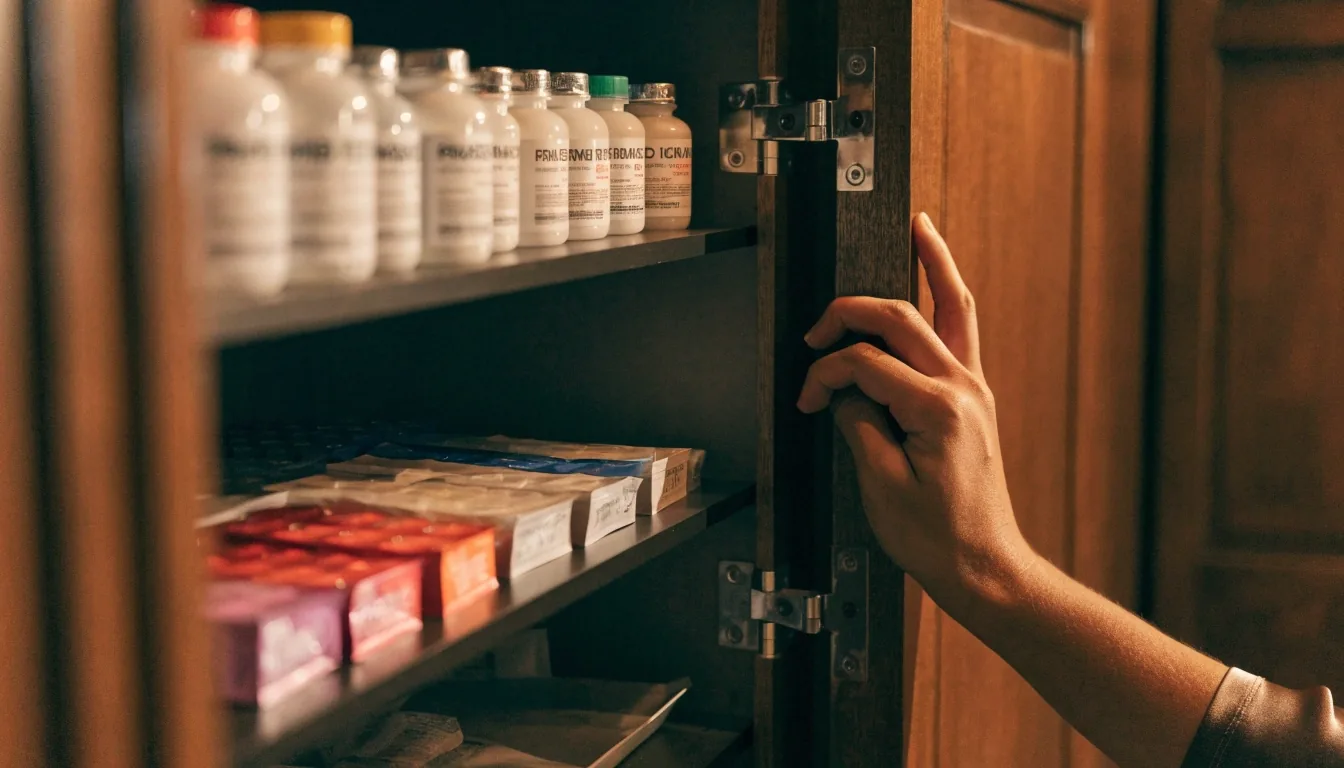
Keep it closed, keep it out of the sun, keep the full container
In a Jakarta kitchen, the worst shelf is the one above the stove. Steam, radiant heat and daylight are the three things a supplement shelf has to survive, and a cabinet door fixes all three. If your bottles live on the counter because that shelf is prettier, they are paying for it every day.
Keep
The original container and the desiccant packet. Together they hold the date, the batch and the moisture barrier.
Avoid
The stove-side shelf, the car glovebox and any spot that catches direct afternoon sun through a window.
Stop
Using the product if its colour or smell shifts before the expiry date, even when the date still looks fine.
Send us the question we have not answered
If your question is about ingredients, formats, labels or daily routine, write to us and we will work it into this page. A short note is enough — tell us what you were comparing and which line on the label you were unsure about.
- Email [email protected]
- Telephone +62 21 523 7223
- Jl. HR Rasuna Said Blok X-5, Kuningan, Jakarta Selatan, 12940
- Monday to Friday, 9:00 AM – 6:00 PM
Still reading
Where to go next
Each page answers a different half of the same question. Start with whichever one matches the decision you are actually making today.